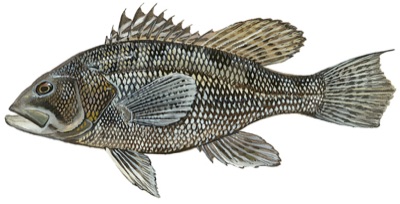
Black Sea Bass
Centropristis striata. Prime water reaches Penobscot Bay in New England right now (57°F on the bottom). Fish it 33–71 ft down — that is where 55–55°F water sits off Penobscot Bay.
The water column off Penobscot Bay
The strip is the water itself, coloured by temperature from the surface down to the 71 ft surveyed bottom at that spot — one band per RTOFS model level. The outlined stretch is where Black Sea Bass's temperature band (46–79°F) and the depth it holds actually overlap. That thickness is the number that matters: it is how much water you can work, not just whether the spot is warm enough somewhere. One model cycle, not a weekly archive — this holds still while the surface map scrubs.
In 3D
.png)
How it's fished
Squid or clam on hi-lo rigs directly over wrecks, reefs and rockpiles.
Region by region — right now
| Region | Season | Prime water | Temp | Fish it at | Months |
|---|---|---|---|---|---|
| New England | in season | reaches Penobscot Bay | 57°F | 33–71 ft | J F M A M J |
| Mid-Atlantic | in season | reaches Montauk | 65°F | ~60 ft | J F M A M J J A S |
| Southeast Atlantic | off-season | reaches Cape Hatteras | 77°F | ~60 ft | J F M A M J J |